Looking for an Otter AI Alternative? Here Is Why UK Teams Choose Keel
Looking for an otter ai alternative? UK teams cite three reasons they move: US data residency, a bot in the call, and GDPR uncertainty. This article explains each one and shows what Keel does differently.
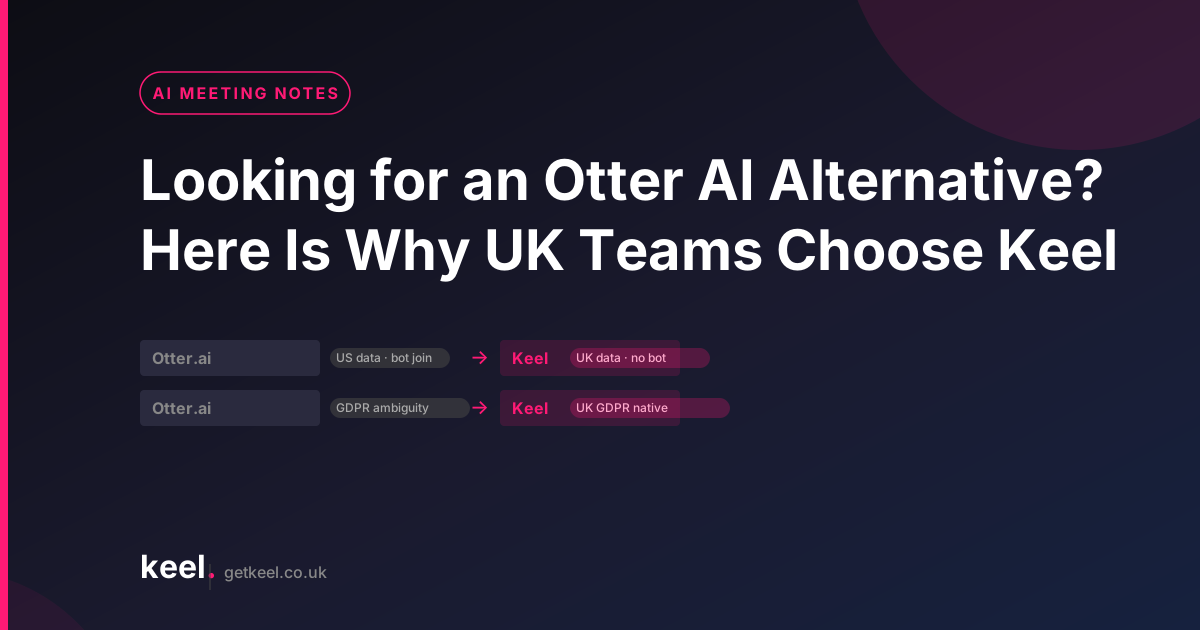
If you are searching for an otter ai alternative, you are almost certainly already frustrated — not with AI meeting notes as a concept, but with something specific. A bot that appears in your Teams or Zoom call as a named participant. A GDPR conversation you have been putting off. A DPO who cannot get a clean answer about where the audio goes. These are the three complaints UK finance and professional-services teams raise about Otter.ai, and every one of them is solvable. This article explains each complaint in plain terms and shows how Keel — a device-first, UK-hosted AI meeting tool — addresses them directly.
What UK Teams Actually Complain About with Otter.ai
Otter.ai is a capable product. The transcription is accurate, the action-item extraction is useful, and the integrations are solid. But three things come up consistently when UK teams discuss switching.
The bot joins the call
Otter.ai records meetings by sending a bot into the call as a participant. It joins Teams, Zoom or Google Meet and appears in the attendee list — sometimes as "Otter.ai Note Taker", sometimes under a label you can configure. For internal team meetings, most people get used to it. For external meetings — client calls, supplier negotiations, candidate interviews — it creates social friction that most teams would rather avoid.
A client who did not expect a third party in the call will notice. A candidate who sees an unfamiliar name in the attendee list during an interview may wonder what happens to the recording. You end up briefing people in advance or handling the awkward moment when they ask. Neither is the end of the world, but neither is how you want to start a meeting.
The data sits in the United States
Otter.ai is a US company. Audio processed through its standard service routes through US infrastructure. For UK teams, this raises several information governance questions: does this transfer require a documented mechanism under UK GDPR? Is there an International Data Transfer Agreement (IDTA) or adequacy decision in place? Who do we contact if we receive a data subject access request covering recordings?
Otter does publish a Data Processing Addendum, but working through its terms to satisfy a data protection officer takes time, and the answers depend on which Otter product tier you are using and which infrastructure region applies. For UK teams in regulated industries, "it is available if you ask" is not the same as "it is already sorted".
GDPR ambiguity
The combination of bot-join, US hosting, and a product built primarily for the US market creates a governance story that is harder to close than it needs to be. UK teams in legal, financial services, and consulting have found it difficult to get a clean sign-off from their information governance function. Not because Otter.ai is non-compliant — compliant use is possible — but because the effort required to document that case exceeds what most teams want to spend on a productivity tool.
None of these problems makes Otter.ai unusable. But if you are looking for an otter ai alternative, one of the three is almost certainly the reason.
Otter AI Alternative for UK Teams: What Keel Does Differently
Keel is designed around three architectural decisions that directly address the complaints above. They are not marketing claims — they are the choices that determine how the data governance story reads when you present it internally.
No bot in the call
Keel captures audio device-first. It records directly from the microphone and speaker of the machine running the meeting — not by joining as a participant. There is no named attendee in your call. There is no moment where a client notices an unfamiliar name in the attendee list. The meeting looks and behaves exactly as it would without a note-taking tool running.
This is the single biggest practical difference for teams with frequent external meetings. The social friction disappears entirely.
UK data residency
Audio captured by Keel is processed and stored in the UK. There is no transatlantic transfer in the standard processing flow. For your information governance record, the answer to "where does the audio go?" is straightforward: UK infrastructure, under UK GDPR and the Data Protection Act 2018. Your data protection officer does not need to audit an IDTA or navigate US-law carve-outs to arrive at a sign-off.
A short, auditable processing chain
Because Keel does not route audio through a chain of third-party sub-processors, your record of processing activities is concise. Who processes the audio? Keel. Where is it stored? UK infrastructure. When is the raw audio deleted? After the note is produced and verified, if you apply the minimum-retention posture that UK GDPR data-minimisation guidance recommends.
That is the governance answer most DPOs want to hear. It is also the one that takes the least time to document.
A UK Example: How a Leeds Professional-Services Firm Made the Switch
A professional-services firm based in Leeds — around 40 fee-earners, client work across financial advisory and restructuring — had been using Otter.ai for fourteen months when a GDPR audit flagged the US data transfer. Nothing had gone wrong. There had been no breach, no complaint, no incident. But the firm's data protection register listed "TBD" against the audio-processing sub-processor, and the DPO could not locate the signed DPA that should have been in place.
The decision to switch was not driven by dissatisfaction with Otter's accuracy — the transcription was fine. It was driven by a simple operational requirement: the firm needed to be able to answer the question "where does the audio go?" in one sentence, without a footnote about US transfer mechanisms.
After a two-week pilot with Keel, the IT lead sent the DPO a single-paragraph summary: device-first capture, UK infrastructure, raw audio deleted after note production, no bot in the call. The DPO approved in one email. The IT lead noted that this was the fastest governance sign-off for a productivity tool the team had seen in three years.
The secondary benefit — and the one that surprised the fee-earners more than the compliance team — was that client meetings stopped having the "why is there a stranger in the call?" moment. Client-facing staff reported that meetings felt more natural, and that briefing clients about the recording had become a simpler conversation when they could say "there is no bot; it records from the device" rather than "there is a participant called Otter Note Taker and here is what it does with the audio".
Otter AI vs Keel: How They Compare
The comparison below focuses on the governance and attendee-experience dimensions that drive most UK switching decisions. Transcription accuracy and action-item quality are comparable between the two products.
| Feature | Otter.ai | Keel |
|---|---|---|
| Recording method | Bot joins the call | Device-first, no bot |
| Bot in attendee list | Yes | No |
| Data location | US-based (standard) | UK |
| GDPR DPA | Available, US-framed | UK-native |
| Processing chain | Multiple sub-processors | Short, UK-only |
| Transcription quality | Good | Good |
| Action item extraction | Yes | Yes |
| Calendar integration | Yes | Yes |
| UK-based support | No | Yes |
When the Difference Matters Most
The device-first, UK-hosted approach makes the most difference in three situations.
- External meetings with clients or candidates. No bot means no attendee-list surprise. The meeting runs exactly as it would without a recording tool in place.
- Regulated-industry use. Financial services, legal, and advisory firms with active data protection programmes find UK hosting and a short processing chain easier to clear through information governance than a US-based, bot-join product.
- Teams where the DPO is paying attention. If your data protection officer is actively reviewing your tool stack, the governance answer for Keel is materially simpler to document than for a product whose standard processing chain runs through US infrastructure.
If your team is internal-only, works in a low-sensitivity sector, and has already resolved the US transfer question for other SaaS tools, the difference may matter less. But for the firm in Leeds — and for the majority of UK professional-services teams running external meetings with real clients — it is the thing that makes the switch straightforward rather than optional.
Frequently Asked Questions
Is Keel GDPR-compliant?
Keel processes audio in the UK under UK GDPR and the Data Protection Act 2018. Device-first capture means there is no third-party bot sub-processor to map. Your lawful basis (usually legitimate interests for routine business meetings), notice to attendees, and retention policy determine whether your use is compliant — not the tool itself — but Keel is designed to make the governance answer as simple as possible.
Do I need to tell people they are being recorded?
Yes. Transparency is a duty under UK GDPR regardless of your lawful basis. Tell people in the calendar invite and at the start of the meeting. "This meeting is being recorded to produce notes" covers most routine use cases. For sensitive topics — HR, welfare, anything likely to involve special-category data — take advice before recording.
How does Keel compare to Otter.ai for accuracy?
Transcription accuracy is comparable. Both tools produce usable meeting notes with reasonable action-item extraction. The difference is not quality — it is where the data goes and whether a bot joins the call.
Can I try Keel before committing?
Yes. You can see what Keel does and how it handles your specific meeting setup before making any commitment.
The Next Step
If the bot, the US data location, or the GDPR ambiguity is the thing that has been nagging at you about Otter.ai, Keel is worth a look. The Otter AI alternative page explains how Keel handles the specific scenarios that matter to UK teams — external meetings, regulated industries, and the governance sign-off that most productivity tools turn into a three-month project.
Device-first. UK-hosted. No bot in the call. If that is the answer your information governance function has been waiting for, that is what Keel is built to provide.