How to Get to Inbox Zero: A Practical System for Busy Professionals
A step-by-step system for reaching inbox zero and staying there — four decision rules, a backlog approach, and scheduled triage for busy UK professionals.
Inbox zero is one of those productivity goals that sounds obvious until you try to reach it. The principle — an email inbox maintained at, or near, zero messages — was popularised by Merlin Mann in 2007, but the phrase has since become shorthand for something broader: a systematic approach to email that removes the low-level stress of a perpetually full inbox. If you have ever searched for how to get to inbox zero, you already know the problem. The inbox is not empty because you have not read your messages. It is not empty because you work in an industry where email is unavoidable. It is not empty because you lack discipline. It is not empty because you have never had a system — or because the system you tried required more effort to maintain than the inbox itself.
This guide lays out a practical system for reaching inbox zero and, more importantly, staying there. It treats the inbox as a decision queue, not a storage unit, and it addresses the most common reason the system breaks down: the fact that most email management advice assumes you have spare time in which to manage your email.
Why Most Inbox Zero Approaches Break Down
The classic inbox zero system relies on four decisions: delete, archive, respond (if it takes under two minutes), or defer (if it takes longer). That framework is sound. The problem is implementation. A knowledge worker in a busy UK organisation receives between 80 and 120 emails per day. Even if each decision takes ten seconds, clearing 100 messages requires nearly twenty minutes of sustained triage — before any actual work begins. At that pace, the system runs until something more pressing arrives, at which point the inbox recovers to its previous state within a week.
The second failure mode is the perpetual-defer category. Messages that need a longer response accumulate in a "to do" folder that behaves exactly like the inbox did before: a list of things that feel urgent, require action, and have no clear order of priority. The inbox has been emptied; the cognitive load has simply been moved one folder to the left.
A working inbox zero system addresses both of these. It reduces the cost of individual decisions, and it ensures that deferred items are treated as tasks rather than emails.
Step One: Process, Not Just Read
The inbox is a decision queue. Reading a message is not the same as processing it. Processing means making a decision about the message and acting on that decision immediately. The moment you open a message and think "I will deal with this later" without doing anything, you have done the costliest possible thing: read the message twice, spent attention on a decision you did not make, and left the inbox in exactly the same state as before.
The discipline of inbox zero starts here, before any folder structure or tool is involved. When you open the inbox, you process. You do not browse.
Processing, in practice, means asking four questions in sequence:
- Does this require any action at all? If not, delete it or archive it immediately. Newsletters, notifications, confirmations and automated messages that require no action should never occupy decision space.
- Can I respond in under two minutes? If yes, do it now. The response does not need to be complete — it can acknowledge receipt and set a clear expectation about when a full response will arrive. What it must not do is sit in the inbox while you think about it.
- Is this something someone else should handle? If yes, forward it and archive the original. Document the delegation somewhere outside the inbox — a task manager, a shared board, a note. The inbox is not an accountability system.
- Does this require a longer response or action from me? If yes, it is a task. Convert it to one, set a date if it is time-sensitive, and archive the email. The task system, not the inbox, is where it lives now.
How to Get to Inbox Zero: The Structural Setup
Before you process the existing backlog, a structural decision is required. There are two schools of thought on folder architecture for inbox zero: the single-archive approach and the categorised-folder approach. Both can work. The single-archive approach is almost always preferable because it reduces the cognitive cost of each decision. Instead of choosing between twelve folders, you make one decision: archive or not. Search has made specific folders largely redundant for retrieval. The energy that goes into deciding where to file a message is energy that could have been spent processing two more.
Set up a single archive folder (or use your email client's built-in archive function). If your organisation or role requires specific filing for compliance or reference, create those folders and auto-file into them using rules where possible — but do not touch them manually as part of your triage process.
Dealing with the Backlog
If you are approaching inbox zero for the first time with a backlog of hundreds or thousands of messages, the correct move is aggressive and counter-intuitive: select everything older than four weeks and archive it in a single action. Not delete — archive. If anything in that group is genuinely critical, the sender will have followed up. If it has not been followed up in four weeks, it is not urgent.
This sounds reckless. It is not. The risk of missing something in a 3,000-message backlog is higher than the risk of missing something you can retrieve from archive in seconds if needed. The backlog is not a to-do list — it is a graveyard. Treating it as a graveyard is the correct approach.
For messages within the last four weeks, apply the four-question process above to each one. Set aside two hours — not during a busy period, and not with notifications on — and clear it completely. Once it is clear, the cost of maintaining it is far lower than the cost of reaching zero from a full inbox.
A UK Professional Services Example
Consider a marketing director at a mid-sized UK professional services firm — 200 staff, three regional offices, a high volume of internal and client communication. Before adopting an inbox zero approach, she processed email in the conventional way: reading when she could, flagging things for follow-up, keeping messages in the inbox as a reminder. By mid-week, the inbox reliably sat at 400-600 messages. By end of month, it had exceeded 1,000 on three consecutive occasions.
The emotional cost was significant. The inbox had become a source of ambient anxiety — not because the messages were urgent, but because their presence implied obligation. Every time she opened the inbox, she was reminded, simultaneously, of everything she had not done. The reading-but-not-deciding pattern meant she was routinely rereading the same messages four or five times before acting on them.
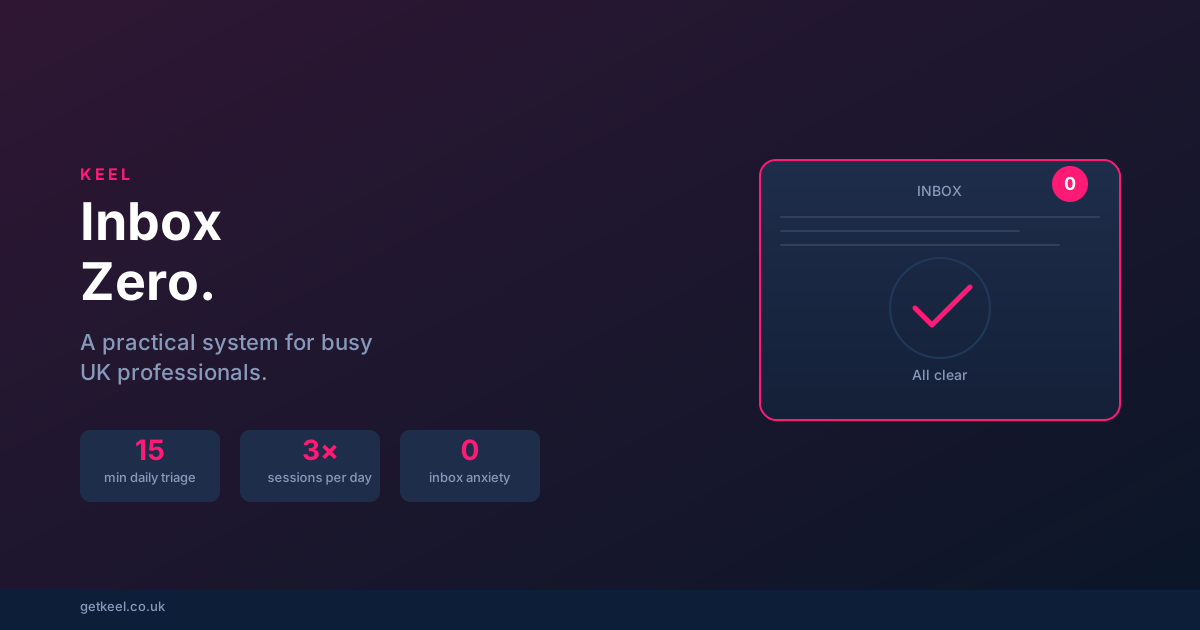
After implementing the process-not-read discipline and the single-archive approach, she cleared the backlog in one two-hour session and maintained inbox zero through a daily fifteen-minute triage. What changed was not the volume of email — that stayed the same. What changed was the number of times each message was handled. Once, then archived. The cognitive load reduction was immediate and lasting.
The Maintenance System: Three Triage Sessions Per Day
Inbox zero is not a destination. It is a recurring state that requires scheduled maintenance. The single biggest mistake people make after reaching zero is checking the inbox reactively — opening it whenever a notification arrives, processing a few messages, and leaving the rest for "later." Later compounds. Three scheduled triage sessions per day — morning, after lunch, and late afternoon — handle the volume for most UK knowledge workers without creating the reactive pattern that undermines the system.
Between sessions, notifications should be off. This is the part of inbox zero advice that most people resist and almost everyone who succeeds at the system eventually endorses. The cost of an interrupt is not the thirty seconds it takes to read a notification. It is the time to return to focused work, which cognitive science research consistently places at fifteen to twenty minutes per interrupt. A professional receiving twelve notifications per working day is not losing six minutes. They are losing a substantial portion of their productive capacity.
When Manual Triage Is the Bottleneck
For most professionals, the system above is sufficient. For those in roles where email volume is very high — 150 messages per day and above — or where the triage decision itself is consistently difficult, the bottleneck is not discipline. It is the triage decision itself. When important messages look identical to unimportant ones, or when the cost of scanning to find what needs a decision outweighs the time saved by triage, the manual system has reached its limit.
The Three Rules That Hold the System Together
After reaching zero, three rules preserve it:
- Nothing lives in the inbox. The inbox is a transit point, not a storage location. An email that has been read and is waiting for a response is a task. Move it to the task system.
- Process on schedule, not on demand. Scheduled triage sessions, notifications off between them. Without this, the system reverts within a week.
- Archive is not the same as delete. Archiving is the correct response to anything that requires no action. The fear of archiving — "what if I need it?" — is almost always unfounded. What matters is that the inbox is not carrying the cognitive weight of everything that has ever landed in it.
Next Steps
If you are managing a professional services or knowledge work team and inbox zero has become an aspiration rather than a practice, the starting point is the same as it is for individuals: one two-hour session to clear the backlog, a structural decision about folders, and three scheduled triage sessions per day. The system holds for most people at that point.
For teams where the volume itself is the problem — where triage takes longer than the time available, or where important messages are being missed because they look the same as unimportant ones — take a look at how Keel approaches email prioritisation. It is designed specifically for the case where the manual system is the right framework but the volume has outgrown what manual triage can handle reliably.
Lee Nash is a productivity and systems consultant, and co-founder of Keel.