How to Write Meeting Minutes (And How to Never Do It Manually Again)
A step-by-step guide to writing meeting minutes that actually get used — what to capture, how to structure them, and how UK teams eliminate the manual work entirely.
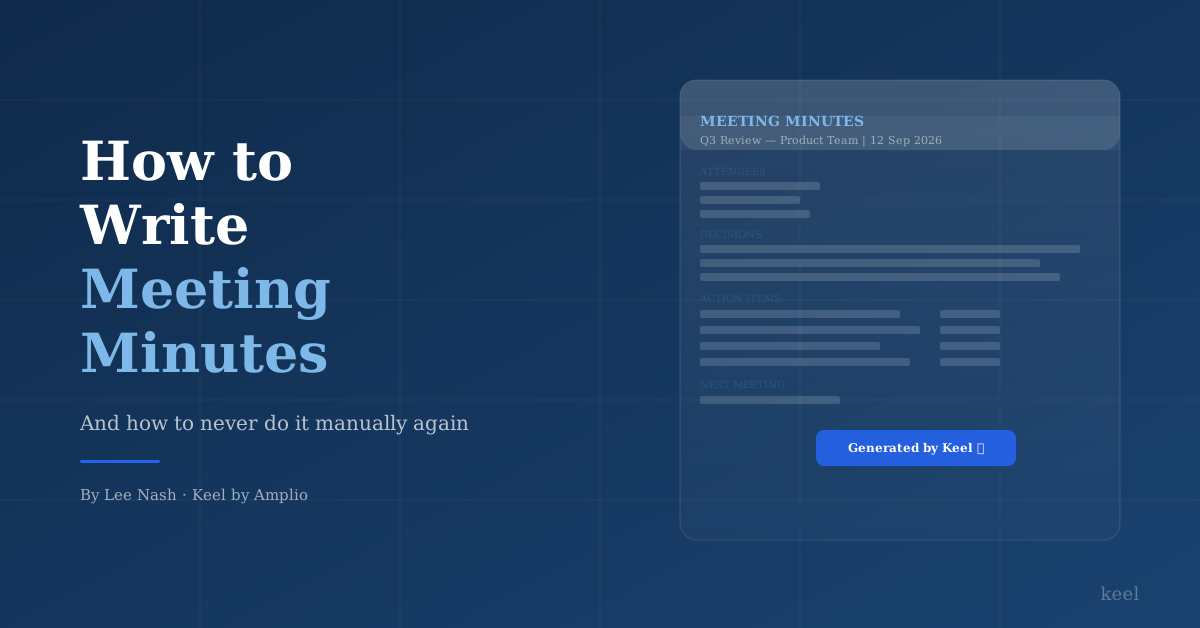
If you have sat in a meeting and realised, three days later, that nobody wrote up what was decided — you understand why knowing how to write meeting minutes properly matters. Meeting minutes are the single record of what happened, who was responsible and what comes next. Without them, decisions evaporate and action items stall in everyone's inboxes. With them, a sixty-minute discussion produces a concrete, searchable, accountable output that drives work forward.
This guide walks through what to capture, how to structure it, and the one approach that UK teams are using to stop spending time on the problem altogether.
What meeting minutes are actually for
The phrase "meeting minutes" comes from the Latin minuta scriptura — small writing. The original idea was a concise record, not a transcript. That distinction matters. Good meeting minutes are not a word-for-word account of everything said. They are a structured summary of:
- Who attended (and who was expected but absent)
- What decisions were made, and the reasoning behind them
- What actions were agreed, by whom, and by when
- Any information shared that people will need to refer back to
- The date, time and location or meeting link
A board of directors uses minutes as a legal record of governance decisions. A project team uses them to keep delivery on track. A sales team uses them to capture client commitments. The format varies, but the purpose is the same: create a single source of truth for what was agreed.
The standard structure for meeting minutes
Whether you are minuting a board meeting, a team check-in or a client call, the structure follows the same pattern. Here is what each section should contain.
Meeting header
Start with the basics: meeting name or type, date, start and end time, location (or video call platform), and the name of whoever is taking the minutes. This sounds obvious, but minutes that lack a date or a clear name become impossible to file and find later.
For example: Product Team Weekly — 12 September 2026, 10:00–11:00, Microsoft Teams. Minutes: Sarah Okafor.
Attendees
List everyone who attended, with their role or team if the list will be read by people outside the meeting. Note any apologies — people who were invited but could not attend. This matters when a decision is challenged later ("I was not in that meeting") or when someone needs to catch up.
Decisions
This is the heart of the document. For each decision, capture:
- What was decided (the outcome, not the discussion)
- Who proposed or championed it, if that context matters
- Whether it was unanimous or by majority
- Any conditions attached to the decision
Write decisions in past tense and plain language. "The team agreed to pause the feature build until the discovery sprint concludes" is better than "Feature build — decision pending discovery." The first can be understood by anyone. The second needs context only you have.
Action items
Action items are where minutes drive real-world change. For each action, you need three things: what it is, who owns it, and when it is due. Without all three, an action item is a hope, not a commitment.
A simple table works well here:
| Action | Owner | Due |
|---|---|---|
| Finalise the Q4 budget proposal | James Whitfield | 19 Sep 2026 |
| Share the vendor shortlist with procurement | Priya Sharma | 15 Sep 2026 |
| Schedule a follow-up with the Edinburgh team | Mark Davies | 16 Sep 2026 |
If your minutes go out by email, copy the action item table into the email body — not just into an attachment. People read what lands in front of them.
Items deferred or tabled
Any agenda item that was not resolved deserves a note. Record what it was, why it was deferred, and when it will be picked up. This prevents items from falling through the gaps between meetings.
Next meeting
Confirm the date, time and location of the next meeting. If it has not been scheduled yet, record that it needs to be arranged and by whom.
How to write meeting minutes in real time
Writing minutes while a meeting happens is harder than it sounds. The conversation moves fast, people interrupt each other, and decisions sometimes emerge gradually rather than arriving cleanly announced.
These practices help:
Prepare the template in advance. Have your structure ready before the meeting starts — header, attendee list pre-filled with expected attendees, agenda items as section headings. You are then filling in boxes rather than constructing a document from scratch while trying to listen.
Capture decisions and actions, not discussion. You do not need to record the journey. You need to record the destination. When a decision is made, write it down immediately. When someone says "I will handle that by Friday," write it down as an action item before the conversation moves on.
Use shorthand, then clean up afterwards. It is faster to capture rough notes during the meeting and spend fifteen minutes sharpening them afterwards than to try to write perfect prose while the meeting is live. Keep a separate space for rough notes alongside your clean template.
Clarify ambiguity before you leave the room. If you are not sure whether something was a decision or a discussion, ask. "Just to confirm — we have agreed to proceed with Option B?" costs ten seconds and prevents a confusing document.
Distribute within 24 hours. Minutes lose value quickly. The longer you wait, the more people have started acting on their own interpretations of what happened. Send the minutes the same day if possible, and certainly before the next working day.
Common mistakes when writing meeting minutes
Even experienced minute-takers fall into these traps.
Including too much detail. Minutes that read like a transcript are not read. If your minutes routinely run past two pages for a one-hour meeting, you are capturing discussion rather than decisions. Cut everything that does not directly help someone understand what was decided or what they need to do.
Vague action items. "Follow up on the supplier issue" is not an action item. "Confirm the revised delivery schedule with Henderson Logistics by 18 September" is. The more specific the action, the more likely it gets done.
Missing the absent attendees. Minutes are as important for the people who were not there as for those who were. Write with that reader in mind. Do not assume context that was only established in the room.
No owner on action items. An action owned by "the team" is owned by no one. Every action needs a named individual.
Storing minutes somewhere they will never be found. Minutes filed in a shared drive that nobody uses, sent to an email list that gets buried, or saved to a tool that half the team does not access — all of these mean the document exists and has no effect. Decide where minutes live and make sure every attendee knows where to find them.
The UK context: board minutes and legal requirements
For UK limited companies, board meeting minutes have a specific legal status. Under the Companies Act 2006, companies are required to keep minutes of all board meetings and general meetings, and to retain them for at least ten years. They must be available for inspection by shareholders and, in certain circumstances, by companies house and HMRC.
Board minutes should record resolutions clearly and be signed by the chair. If your company is small and the directors are also shareholders, this may feel like paperwork for its own sake — but the requirement applies regardless of company size. A dispute over a director's authority, a transaction that is challenged, or an HMRC inquiry can all turn on what the minutes do or do not record.
For most operational meetings — team stand-ups, project reviews, client calls — there is no legal requirement to keep minutes, but the practical benefit is the same: a record that decisions were made and responsibilities were assigned.
How to stop writing meeting minutes manually
Knowing how to write meeting minutes is useful. Not having to write them manually is better.
Most of the effort in minute-taking — capturing decisions, pulling out action items, noting who said what — is pattern recognition applied to spoken language. It is exactly the kind of task that AI meeting tools now handle well. Keel produces a structured meeting summary the moment the meeting ends, with decisions, action items (each with an owner and a due date), and a full transcript available for reference. There is no cleanup, no fifteen-minute formatting session, no chasing people for their action items the following week.
For a finance team at a UK professional services firm, that means every partner call, every client review and every internal governance meeting produces a consistent, searchable record — automatically. The partners get more out of each meeting. The administrative overhead disappears.
Critically, Keel does not join the call as a bot. It works without adding a third-party participant to the meeting, which matters for client calls where a bot appearing on screen raises questions about data handling and confidentiality. UK GDPR compliance is built in.
If you have read this guide because you want to do meeting minutes properly, you are already thinking about the right things: capturing decisions, assigning owners, distributing promptly, storing accessibly. The next step is removing the manual work between those intentions and the outcome.
See how Keel handles meeting minutes automatically for UK teams.