The AI Note Taker Without Bot Join-Ins: Why Yours Shouldn't Join the Call
Why an AI note taker without bot join-ins beats sending a bot into your call: the privacy, GDPR and UX case for device-audio meeting capture for UK teams.
Keep the bot out of the call. An AI note taker without bot join-ins captures the meeting from your own device — the same audio you already hear — instead of sending a third-party participant into the room to sit, record, and listen on everyone's behalf. For UK teams in finance, professional services, and sales, that single design choice removes most of the awkwardness, consent friction, and data-governance headaches that meeting bots create. You get the notes. Nobody else gets a seat at the table.
That is the honest case, and it has limits. Below is what a meeting bot actually does, where bot-free capture wins, and the genuine scenarios where a bot is still the better tool.
What a "meeting bot" actually is
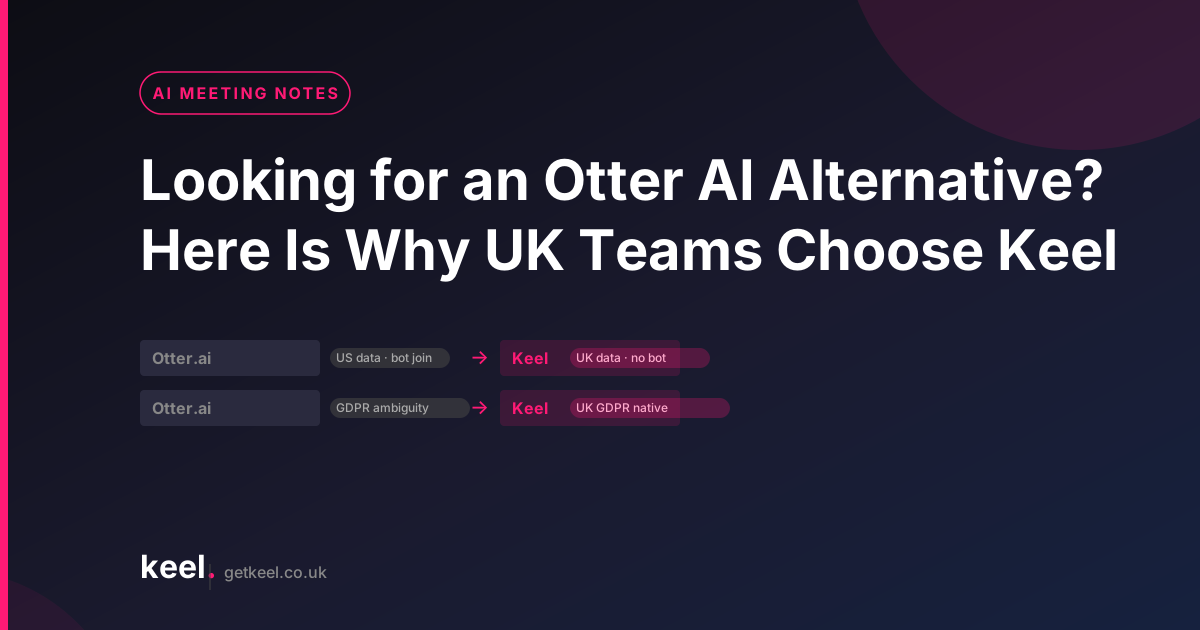
When you connect a typical AI notetaker to your calendar, it dials into your calls as a named participant — "Otter.ai", "Fireflies Notetaker", "Read AI" — appearing in the attendee list alongside real people. It joins the Zoom, Teams, or Meet session, records the stream on the vendor's cloud, transcribes it, and posts a summary.
Mechanically, the bot is a separate attendee with its own microphone permissions and its own copy of your conversation. Everyone can see it. Everyone it records is being recorded by a company that was never invited to the relationship — only to the meeting.
Device-audio capture works differently. A tool like Keel Notes records the audio playing on your machine plus your microphone, locally, then processes it. No extra participant appears. The meeting looks exactly as it would if the software weren't there.
The privacy and consent problems with bots
This is where the trade-off gets concrete, and where UK teams should pay attention.
A visible extra participant changes the meeting. Under UK GDPR, recording a conversation means processing personal data, and you need a lawful basis plus appropriate transparency. A bot in the attendee list is honest in one sense — people can see it — but it also broadcasts to every external guest that a third-party vendor is now holding their words. That is a harder conversation to have with a prospective client than a quiet "I take AI notes on my device, is that alright?"
Recordings land on a third party's cloud. With a bot, your client's commercially sensitive discussion is copied to the notetaker vendor's infrastructure, wherever that sits. You inherit their retention defaults, their sub-processors, and their breach exposure. For regulated firms, that is another data-processing agreement to paper and another supplier to audit.
Who is the data controller? With a bot recording on the vendor's platform, the lines blur — you decide the purpose, but the vendor holds and processes the raw audio at scale, sometimes reserving rights to improve their models. With on-device capture, you keep control of the recording from the first second and decide exactly what leaves your machine, which makes the controller/processor relationship far cleaner to document.
None of this makes bots unlawful. It makes them heavier. Every extra party touching the audio is another line in your record of processing activities.
The UX and trust problems
Beyond compliance, bots create friction you feel in the room.
- External guests find it awkward. A "Notetaker" joining a first sales call reads as surveillance to some prospects. Trust is the product in professional services; you don't want a robot undermining it in the first thirty seconds.
- Bots get kicked — or blocked entirely. Many corporate IT policies bar unknown participants from Teams and Zoom. The bot is refused entry, and you lose the notes with no fallback.
- They cannot cover the conversations that matter most. No bot can join an in-person meeting round a table, a corridor catch-up, or a phone call on your mobile. A large share of real decisions happen exactly where a bot cannot go.
Device-audio capture sidesteps all three. If you can hear it, it can note it — video call, phone, or face to face.
The security angle: fewer hands on the audio
Security people think in terms of attack surface: every system that holds a copy of sensitive data is somewhere it can leak from. A bot-based flow means your audio exists on the meeting platform and the notetaker vendor's cloud and wherever they back it up. Bot-free, device-first capture keeps the number of parties smaller and the chain shorter. Fewer copies, fewer processors, fewer places a mistake can happen.
Bot vs bot-free: the honest comparison
| Meeting bot (joins the call) | Bot-free / device-audio (Keel Notes) | |
|---|---|---|
| Visible extra participant | Yes — appears in attendee list | No — nothing joins |
| In-person & phone meetings | Not supported | Supported |
| Blocked by corporate IT | Often | Rarely — no join to block |
| Where audio is recorded | Vendor cloud | Your device first |
| Full video recording | Usually available | Audio-and-notes focused |
| Fully async / you-not-present | Works — bot attends alone | Needs you (or someone) in the meeting |
| Platform-native transcript | Yes, if integrated | Separate from the platform |
Where a bot is genuinely the better choice
We would rather you pick the right tool than pick us for the wrong reasons. A meeting bot beats device capture when:
- You need a full video recording, not just notes — for training libraries, webinars, or content you'll re-edit. A bot capturing the video stream does this natively; device-audio tools focus on the words.
- Nobody attends live. If a call must be recorded when no one on your side is present — an interview panel you've delegated, or a session you can't make — a bot can sit in on its own. Device capture needs a device in the meeting.
- You want the platform's own transcript and timeline, tightly wired into Zoom or Teams with speaker labels driven by the platform's identity, and your governance team is already comfortable with that vendor.
If that's you, choose the bot with open eyes. For a wider view of the market, our guide to the best AI meeting notetakers of 2026 compares both approaches without the sales gloss.
Frequently asked questions
Is it legal to record a meeting in the UK?
Generally yes, provided you have a lawful basis under UK GDPR and are transparent about it. Recording for your own note-taking and business records is usually straightforward; problems arise from covert recording or unclear retention. Tell people, document why, and delete when you no longer need it.
Do I still need consent if there's no bot?
You still need a lawful basis and transparency — the absence of a visible bot doesn't remove your obligations. In practice a brief verbal heads-up ("I'll take AI notes on this call") plus a line in your privacy notice covers most business meetings. The difference is that the conversation is calmer when no third-party participant is staring back at your guest.
Does it work for in-person and phone meetings?
Yes — that's a core advantage. Because Keel Notes captures the audio on your device rather than joining a video call, it works for face-to-face meetings and phone conversations where no bot could ever attend. A bot-based tool simply cannot cover these.
Is my meeting data actually private?
With device-first capture, the recording starts and stays under your control, and you decide what's processed and kept — rather than a copy living by default on a notetaker vendor's cloud. Fewer parties touch the audio, which is easier to explain to clients and to your own compliance team. Always check any tool's retention and sub-processor terms before you commit.
Ready to talk it through?
If you're weighing a bot-based notetaker against device-audio capture, we're happy to give you the straight version — including the cases where a bot suits you better.